
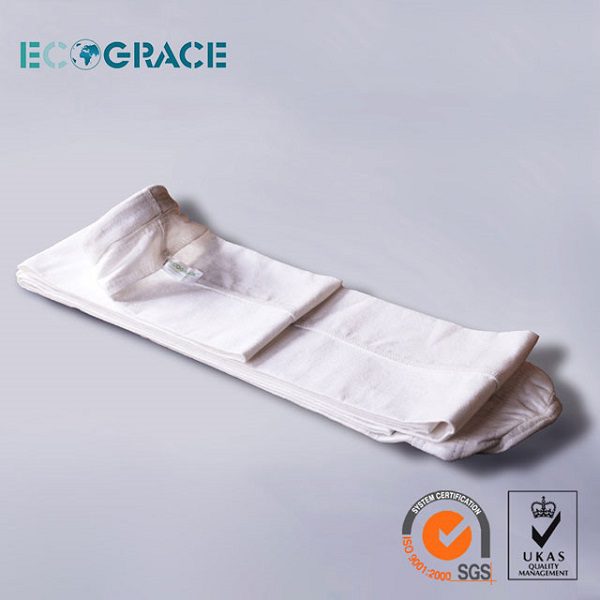
Ferroalloy Filter Bags
Submerged Arc Furnace Fume & Dust Collection for Ferrosilicon, Ferromanganese, Ferrochrome & Silicomanganese Production
Engineered by ECOGRACE
Product Overview
ECOGRACE ferroalloy filter bags are purpose-engineered for the extreme dust loading, ultra-fine silica fume, and high-temperature operating conditions unique to ferroalloy smelting. Submerged arc furnaces (SAF), open arc furnaces, and refining ladles used in ferrosilicon, ferromanganese, ferrochrome, and silicomanganese production generate massive volumes of amorphous micro-silica (SiO2) fume — particles typically 0.1–0.5 µm in diameter — at concentrations reaching 20–50 g/Nm³ and temperatures of 180–260°C. This ultra-fine, cohesive fume is among the most difficult dust types to capture and release in all industrial filtration.
Our ferroalloy filter bags deliver ≥99.99% capture efficiency for sub-micron silica fume with PTFE membrane surface filtration technology. The membrane prevents fine SiO2 particles from penetrating into the fiber matrix — the root cause of irreversible pressure drop rise and premature bag failure in conventional depth-filtration ferroalloy filter bags. With proper membrane technology, outlet emissions consistently fall below 5 mg/Nm³ while maintaining stable, low differential pressure across the full bag service life.
With proven installations across ferrosilicon plants in China, Norway, Iceland, and Brazil, silicomanganese smelters in South Africa and India, ferrochrome producers in Kazakhstan and Turkey, and ferromanganese operations globally, ECOGRACE provides dust collector filter bags that meet EU BAT-AEL, US EPA MACT, and the most stringent national emission regulations for ferroalloy production worldwide.
Ferroalloy Filter Bags by Smelting Process
Ferrosilicon (FeSi) Smelting
The most demanding ferroalloy filter bag application. FeSi submerged arc furnaces produce the highest concentration of amorphous micro-silica fume (30–50 g/Nm³) at 180–240°C. This ultra-fine SiO2 (<0.3 µm median) is extremely cohesive and rapidly blinds conventional depth-filtration media. PTFE membrane filter bags on fiber glass substrate are essential for stable pressure drop and consistent micro-silica recovery.
Silicomanganese (SiMn) Production
SiMn smelting generates a mixed fume of silica and manganese oxide (MnOx) at 180–220°C with dust loading of 15–35 g/Nm³. Manganese fume is a regulated toxic substance requiring strict emission control. Ferroalloy filter bags for SiMn must combine high-efficiency sub-micron capture with excellent chemical resistance to manganese-bearing dust and CO gas breakthrough events from furnace upsets.
Ferrochrome (FeCr) Smelting
FeCr submerged arc furnaces produce chromium-bearing fume containing hexavalent chromium (Cr6+) — a known carcinogen requiring the strictest emission control. Fume temperature ranges 160–220°C with moderate dust loading (8–20 g/Nm³). Ferroalloy filter bags for ferrochrome demand PTFE membrane to capture sub-micron Cr6+ particles and prevent any fiber penetration of this highly toxic dust.
Ferromanganese (FeMn) Production
High-carbon and medium-carbon FeMn smelting generates manganese oxide fume at 160–200°C with dust loading of 10–25 g/Nm³. CO gas is present in closed furnace off-gas, requiring explosion-proof baghouse design and anti-static ferroalloy filter bags. PPS filter bags or NOMEX filter bags with PTFE membrane and conductive anti-static fiber blending for safe operation.
Ferrovanadium & Ferrotungsten
Specialty ferroalloy production in electric arc or induction furnaces generates heavy metal fume (V2O5, WO3) at 180–240°C. Vanadium pentoxide is highly toxic and regulated at microgram levels. Ferroalloy filter bags for specialty alloy smelting require PTFE membrane on fiber glass with acid-resistant finish to capture and safely contain these regulated heavy metal fume particles for proper disposal or recovery.
Silicon Metal (Si) Production
Metallurgical-grade silicon smelting produces the highest purity amorphous silica fume at 200–260°C — a valuable by-product for concrete, refractory, and semiconductor industries. Ferroalloy filter bags for silicon metal must maximize micro-silica recovery yield and purity while maintaining the lowest possible outlet emission. Fiber glass with PTFE membrane and food/pharma-grade surface treatment for high-value silica fume collection.
Recommended Filter Media for Ferroalloy Filter Bags
Fiber Glass Filter Bags
The primary substrate for ferroalloy filter bags in submerged arc furnace applications. Continuous temperature rating up to 280°C handles the highest SAF fume temperatures with ample safety margin. Woven fiber glass with PTFE finish provides excellent dimensional stability under the sustained high-temperature exposure and heavy dust loading unique to ferroalloy smelting. The industry-proven standard for FeSi and silicon metal production.
NOMEX Filter Bags
NOMEX filter bags (meta-aramid) operate continuously at 200°C with superior mechanical strength and abrasion resistance. Ideal for ferromanganese, silicomanganese, and ferrochrome ferroalloy filter bag applications where moderate temperature combined with abrasive ore dust and conveyor transfer point collection demands exceptional fabric durability and flex fatigue resistance.
PPS Filter Bags
Continuous operating temperature up to 190°C with outstanding acid and alkali resistance. Cost-effective for lower-temperature ferroalloy filter bag applications: raw material handling, screening, crushing, and furnace charging systems where chemical corrosion from SO2 or moisture is present but temperature remains below 190°C. Excellent hydrolysis resistance in humid environments.
PTFE Membrane Lamination
The critical technology upgrade for all ferroalloy filter bags. PTFE membrane surface filtration captures amorphous micro-silica on the bag surface rather than allowing it to penetrate fiber depth. This prevents the progressive, irreversible pressure drop increase that destroys conventional depth-filtration bags in ferroalloy service within 6–12 months. Mandatory for any ferroalloy filter bag application targeting <5 mg/Nm³ outlet emission and >24 months service life.
Material Comparison for Ferroalloy Filter Bags
| Material | Max Temp | Best Ferroalloy Application | Silica Fume Handling | Abrasion Resistance | Service Life |
|---|---|---|---|---|---|
| Fiber Glass + PTFE Membrane | 280°C | FeSi SAF, silicon metal, FeCr | Excellent | Moderate | 24–36 months |
| NOMEX (Aramid) + PTFE Membrane | 200°C | FeMn, SiMn, material handling | Good | Excellent | 24–36 months |
| PPS + PTFE Membrane | 190°C | Low-temp FeMn, raw material handling | Good | Good | 24–36 months |
| P84 (Polyimide) + PTFE Membrane | 240°C | High-temp FeSi, specialty alloys | Excellent | Good | 24–36 months |
| Fiber Glass + PTFE Membrane (Anti-static) | 280°C | Closed SAF with CO gas, FeMn | Excellent | Moderate | 24–36 months |
Technical Parameters — Ferroalloy Filter Bags
| Parameter | Specification |
|---|---|
| Filtration Efficiency | ≥99.9% standard / ≥99.99% with PTFE membrane at 0.3 µm |
| Outlet Particulate Emission | <10 mg/Nm³ (standard) / <5 mg/Nm³ (PTFE membrane) |
| Operating Temperature Range | 160°C – 280°C (material dependent) |
| Inlet Dust Loading | 8–50 g/Nm³ (FeSi SAF up to 50 g/Nm³) |
| Particle Size (Median) | 0.1–0.5 µm (amorphous micro-silica); 1–20 µm (ore dust) |
| Air-to-Cloth Ratio | 0.6–0.9 m/min (SAF fume) / 1.0–1.3 m/min (material handling) |
| Cleaning Mechanism | Pulse-jet (online or offline), 4–6 bar; reverse air for large-diameter bags |
| Service Life | 24–36 months (PTFE membrane) / 6–12 months (conventional depth-filtration) |
| Tensile Strength (Warp/Weft) | ≥800 N/5cm (warp) / ≥1,000 N/5cm (weft) |
| Surface Treatment | PTFE membrane lamination, singeing, calendering, acid-resistant, hydrophobic, anti-static finish |
| Common Bag Diameter | 130 mm, 150 mm, 160 mm, 292 mm (large-diameter reverse air) |
| Common Bag Length | 3,000 mm – 10,000 mm (custom to order) |
| Anti-Static Property | Surface resistivity <109 Ω (conductive fiber blended for CO gas environments) |
| Certification | ISO 9001, ISO 14001, CE, SGS tested |
Why Ferroalloy Plants Need Specialized Filter Bags
Ferroalloy smelting produces some of the most challenging dust in all industrial filtration. The combination of ultra-fine amorphous silica fume, extreme dust loading, high operating temperatures, and toxic heavy metal content makes standard industrial baghouse filter bags wholly inadequate. Cement plant or power station filter bags used in ferroalloy service typically fail within 6–12 months due to irreversible silica depth penetration. Here is why ferroalloy filter bags require purpose-built engineering:
Ultra-Fine Amorphous Silica Fume
FeSi and silicon metal smelting produces amorphous micro-silica with a median particle size of 0.1–0.3 µm — smaller than tobacco smoke. These spherical nano-particles penetrate deep into conventional filter media fiber structure and cannot be removed by pulse-jet cleaning. This causes irreversible pressure drop rise, requiring premature bag replacement every 6–12 months. PTFE membrane on ferroalloy filter bags prevents this destructive depth penetration entirely.
Extreme Dust Loading (Up to 50 g/Nm³)
FeSi submerged arc furnaces generate inlet dust concentrations of 30–50 g/Nm³ — 5 to 10 times higher than coal-fired power plants. This massive dust burden requires ferroalloy filter bags with very low air-to-cloth ratios (0.6–0.9 m/min), heavy-duty construction, and frequent pulse-jet cleaning cycles. PTFE membrane enables efficient cake release even under these extreme loading conditions, maintaining stable differential pressure.
Toxic Heavy Metal Fume
Ferrochrome produces hexavalent chromium (Cr6+), ferromanganese releases manganese oxide (MnOx), and specialty alloys generate vanadium, tungsten, and molybdenum fume — all regulated at strict occupational and environmental exposure limits. Ferroalloy filter bags must achieve ≥99.99% capture of these sub-micron toxic particles with zero fiber penetration to protect workers, communities, and meet emission permits.
CO Gas Explosion Risk
Closed and semi-closed submerged arc furnaces produce off-gas rich in carbon monoxide (CO 60–90% in closed SAF). CO gas breakthrough events during furnace upsets or electrode breaks can introduce explosive gas mixtures into the baghouse. Ferroalloy filter bags for closed/semi-closed SAF applications must incorporate conductive anti-static fibers (surface resistivity <109 Ω) to prevent electrostatic discharge ignition in CO-rich atmospheres.
Micro-Silica Recovery Value
Amorphous micro-silica captured from FeSi and silicon metal SAF is a valuable by-product worth $200–800/ton depending on purity grade. High-quality ferroalloy filter bags with PTFE membrane maximize micro-silica recovery yield and maintain product purity by preventing fiber shedding and contamination. The difference between premium-grade and reject-grade silica fume can be worth more than the filter bags themselves.
High-Temperature Sustained Operation
Unlike batch processes (EAF, BOF) with intermittent operation, ferroalloy submerged arc furnaces run continuously 24/7 for months or years between relining shutdowns. Ferroalloy filter bags operate at sustained high temperatures (180–260°C) without the cool-down periods that allow bags to “rest” in batch processes. This continuous thermal stress demands filter media with exceptional long-term thermal stability and minimal thermal degradation over 24–36 months of uninterrupted service.
Micro-Silica Recovery — Turning Ferroalloy Filter Bag Catch into Revenue
For ferrosilicon and silicon metal producers, the dust captured by ferroalloy filter bags is not waste — it is a high-value by-product. Amorphous micro-silica (also known as silica fume or condensed silica fume) is used as a pozzolanic admixture in high-performance concrete, as a raw material for refractory applications, and increasingly in lithium-ion battery anode manufacturing. Market prices range from $200/ton for basic grade to $800+/ton for densified, high-purity grades meeting ASTM C 1240 and EN 13263 standards.
The quality of micro-silica recovered depends directly on the performance of your ferroalloy filter bags. PTFE membrane surface filtration maximizes recovery yield (capturing the finest 0.1–0.3 µm particles that carry the highest SiO2 content) while preventing fiber shedding and contamination that downgrades product quality. Plants upgrading from conventional depth-filtration bags to PTFE membrane ferroalloy filter bags typically report 8–15% increase in micro-silica recovery volume and 1–2 grade improvements in product quality classification.
ECOGRACE ferroalloy filter bags help ferrosilicon producers transform their baghouse operation from a cost center into a revenue-generating micro-silica recovery operation — with the filter bags paying for themselves through increased by-product value within the first 6–12 months of installation.
Ferroalloy Applications We Serve
ECOGRACE Advantages for Ferroalloy Filter Bags
Alloy-Specific Engineering
Every ferroalloy filter bag order is engineered for your specific alloy type, furnace design (open/semi-closed/closed SAF), off-gas treatment system, and dust characteristics. We analyze your furnace operating parameters, fume composition, temperature profile, and micro-silica quality targets to optimize fiber selection, weight, membrane type, and surface treatment for maximum performance and by-product value.
Proven Sub-Micron Silica Fume Capture
Our PTFE membrane ferroalloy filter bags consistently achieve <5 mg/Nm³ outlet emission while capturing >99.99% of the 0.1–0.3 µm amorphous silica that destroys conventional bags. Verified by continuous monitoring data from operating FeSi and SiMn installations in China, Norway, South Africa, and India. Stable differential pressure maintained across 24–36 months of continuous SAF operation.
Micro-Silica Quality Optimization
For FeSi and silicon metal producers, we engineer ferroalloy filter bags that maximize micro-silica recovery value. Zero fiber shedding, no contamination from surface treatment chemicals, and optimized cake release characteristics that maintain consistent particle size distribution for premium-grade silica fume classification (ASTM C 1240 / EN 13263 compliant).
Complete OEM Replacement Compatibility
Drop-in replacement ferroalloy filter bags for all major dust collector and baghouse OEM systems including Elkem, Outotec (Metso), Tenova, SMS Group, and Chinese-manufactured ferroalloy SAF baghouse equipment. Provide existing bag dimensions and snap-ring/cuff configuration for exact-fit replacements with optimized media for your specific alloy and furnace type.
Frequently Asked Questions — Ferroalloy Filter Bags
What filter bag material is best for ferrosilicon submerged arc furnace fume?
Fiber glass with PTFE membrane lamination is the proven standard for FeSi SAF fume collection at 200–260°C. The fiber glass substrate provides the thermal stability needed for continuous high-temperature operation, while the PTFE membrane prevents irreversible silica depth penetration that destroys conventional ferroalloy filter bags within 6–12 months. For lower-temperature SAF operations (below 200°C), NOMEX filter bags with PTFE membrane offer superior mechanical durability.
Why do conventional filter bags fail so quickly in ferroalloy service?
Amorphous micro-silica from ferroalloy smelting has a median particle size of 0.1–0.3 µm — far smaller than the interfiber pore structure of conventional depth-filtration felt. These spherical nano-particles penetrate deep into the fiber matrix where they permanently lodge and accumulate, causing progressive, irreversible pressure drop rise. No amount of pulse-jet cleaning can remove embedded silica particles. PTFE membrane on ferroalloy filter bags solves this by capturing 100% of silica fume on the bag surface where it forms a releasable cake.
Do your ferroalloy filter bags work with closed SAF off-gas systems?
Yes. For closed and semi-closed SAF operations with CO-rich off-gas (60–90% CO in closed furnaces), we supply ferroalloy filter bags with conductive anti-static fiber blending that maintains surface resistivity below 109 Ω, preventing electrostatic discharge ignition in potentially explosive CO/air mixtures. These are combined with PTFE membrane for optimal fume capture and compliance with ATEX Zone requirements where applicable.
Can your ferroalloy filter bags handle ferrochrome with hexavalent chromium?
Yes. Ferrochrome SAF fume contains hexavalent chromium (Cr6+), a known carcinogen regulated at extremely strict levels (EU OEL: 0.005 mg/m³, EPA: 0.1 µg/m³ ambient). Our PTFE membrane ferroalloy filter bags capture >99.99% of Cr6+-bearing particles with zero fiber penetration, ensuring both stack emission compliance and safe filter bag handling during changeout. We provide material safety documentation for Cr6+ containment certification.
What is the minimum order quantity, pricing, and lead time for ferroalloy filter bags?
MOQ is 200 pieces for standard sizes. Pricing ranges from $10–$28/piece depending on material (fiber glass vs. NOMEX vs. PPS), dimensions (up to 292 mm diameter x 10,000 mm length), PTFE membrane, and surface treatments. Full plant changeout orders (1,000–8,000+ bags) within 25–35 days. Standard delivery 15–25 days. Free samples available for laboratory testing and side-by-side comparison against your current bags.
Request a Technical Quote for Ferroalloy Filter Bags
Contact ECOGRACE for alloy-specific filtration solutions for your ferroalloy smelting operation
[email protected]WhatsApp: +86-13588065995
Learn more about baghouse filter bags from ECOGRACE