
Introduction
Choosing the wrong dust collector filter bags can lead to frequent bag failures, high pressure drop, unplanned downtime, and even regulatory non-compliance. With hundreds of materials, constructions, and certifications available, selecting the right filter media isn’t just about size—it’s about matching your process conditions, dust characteristics, and operational goals. Understanding the dust collector filter bags selection is crucial for optimal performance.
In this comprehensive guide, we’ll walk you through a step-by-step filter bag selection process used by industrial engineers worldwide—so you can maximize efficiency, extend bag life, and reduce total cost of ownership.
By considering the dust collector filter bags selection carefully, you ensure that your system operates efficiently and effectively.
Step 1: Understand Your Dust Characteristics
The type of dust you’re filtering is the #1 factor in filter bag selection.
Ask:
Particle size: Is it coarse (>50µm) or fine (<10µm)? Ultrafine dust (e.g., carbon black, xanthan gum) requires surface-loading media like ePTFE membrane.
Abrasive? Cement, metal oxide, or foundry dust wears out standard bags quickly → choose heavyweight felt (600+ g/m²) or fiberglass scrim.
Sticky or hygroscopic? Sugar, flour, or chemical powders cake on filters → use non-stick PTFE membrane or anti-static treatment.
Explosive? Metal dust (aluminum, magnesium) requires conductive fibers (carbon or stainless steel) to prevent static sparks.
💡 Pro Tip: Conduct a dust sample analysis if unsure. We offer free lab testing for key properties (particle size distribution, moisture content, resistivity).
Step 2: Evaluate Operating Conditions
A. Temperature
<130°C (266°F): Polyester (PET) – economical but not for high heat.
–180°C (266–356°F): Nomex® (aramid) – good for asphalt, cement.
–200°C (356–392°F): PPS (Ryton®) – excellent chemical resistance.
200°C (392°F): Fiberglass or P84® – ideal for boilers, incinerators.
Up to 260°C (500°F): PTFE membrane laminated on fiberglass base.
⚠️ Always include a 20–30°C safety margin above peak temperature.
200°C (392°F): Fiberglass or P84® – ideal for boilers, incinerators.
Up to 260°C (500°F): PTFE membrane laminated on fiberglass base.
⚠️ Always include a 20–30°C safety margin above peak temperature.
B. Gas Composition
Acidic gases (SO₂, HCl): Avoid polyester; use PPS or PTFE.
Alkaline environments: PTFE is chemically inert—best choice.
Organic solvents: PTFE or PPS offer superior resistance.
C. Moisture & Dew Point
If gas temperature drops below dew point, condensation causes blinding. Use hydrophobic PTFE or oil-repellent finishes.
Step 3: Match Filter Media to Your Collector Type
Collector Type Recommended Filter Bag
Pulse Jet Felted media with ePTFE membrane (surface cleaning)
Reverse Air Woven or heavy felt (needs structural strength)
Shaker Woven fabric (flexes without tearing)
✅ For pulse jet systems (most common), needle-punched felt + ePTFE membrane delivers the best cleanability and longevity.
Step 4: Select Construction & Finishing
Weight: 450–550 g/m² for general use; 600–800 g/m² for abrasive dust.
Scrim: Polyester (low temp), fiberglass (high temp), or PPS (chemical).
Seams: Double-stitched or thermally bonded—never single stitch in harsh apps.
Treatments:
Anti-static (for explosive dust)
Water/oil repellent (for sticky or wet dust)
Singeing/glazing (to reduce fiber shedding)
Step 5: Ensure Compliance & Certification
Depending on your industry, you may need:
FDA 21 CFR 177.1550 – food, pharma, cosmetics
EU 10/2011 – European food contact
ATEX – explosive atmospheres (Europe)
ISO 9001 – manufacturing quality assurance
🔍 Always request material test reports (MTRs) from your supplier.
Step 6: Calculate Correct Size & Quantity
Filter bags are sized by:
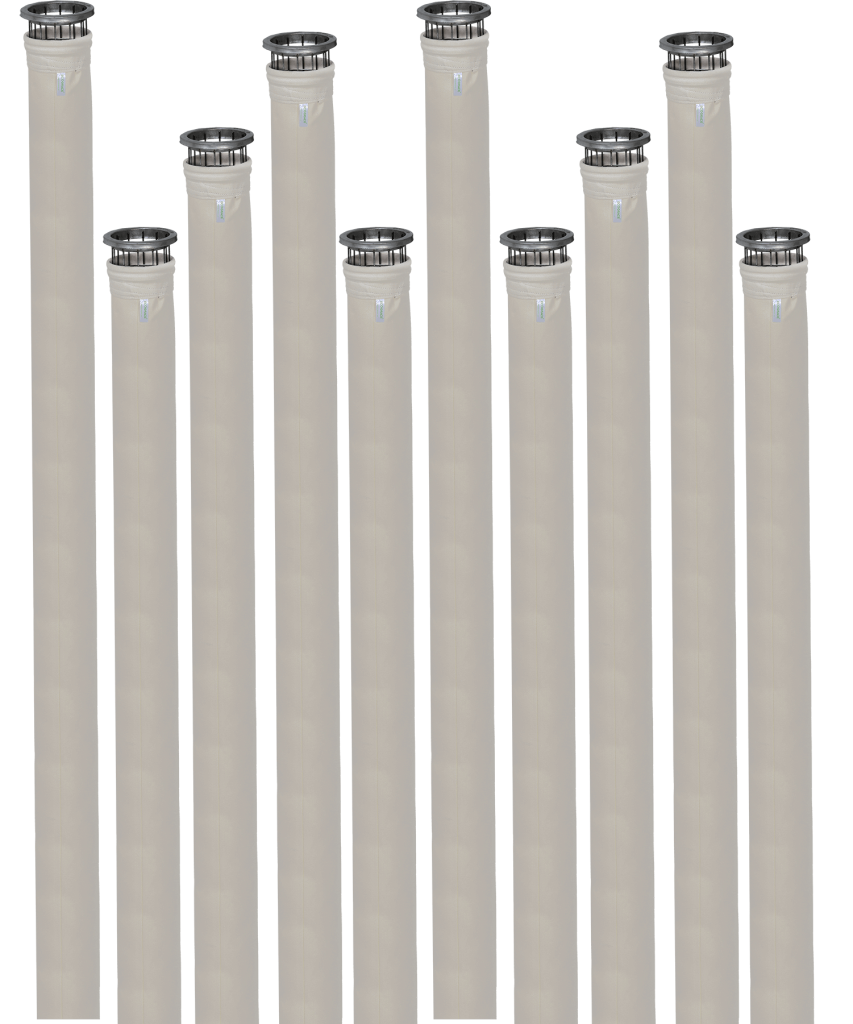
Diameter (typically 120mm, 130mm, 150mm)
Length (1m to 8m)
Top/bottom style (snap band, clamp, raw edge)
Use this formula to estimate air-to-cloth ratio (critical for performance):
Air-to-Cloth Ratio=
Total Filter Area (ft²)/
Total Airflow (CFM)
Recommended ratios:
General industry: 4:1 to 6:1
Fine/sticky dust: 2:1 to 4:1
📐 Need help sizing? → Download our Filter Bag Sizing Calculator (Excel) or Contact our engineers.